
Lars Lang · 21 September 2026
Predictive Modeling Techniques for Supply Chain Optimization Using Borcava
Supply chain professionals rely on predictive modeling techniques to anticipate disruptions, balance inventory levels, and streamline logistics operations, and Borcava serves as the integrated platform that applies these methods through machine learning algorithms and real-time data processing. Researchers have documented how time-series forecasting combined with regression analysis helps organizations project future demand patterns based on historical sales data, seasonal trends, and external factors such as weather events or geopolitical shifts, while Borcava automates the ingestion of these variables into unified models that update continuously.
Core Techniques in Predictive Supply Chain Modeling
Time-series methods form the foundation for many optimization efforts because they capture recurring patterns in shipment volumes and production cycles, yet Borcava extends this capability by layering neural network components that detect subtle correlations across multiple data streams. Classification algorithms identify high-risk suppliers or routes prone to delays, and optimization routines then recommend alternative sourcing decisions that minimize total landed costs. Observers note that ensemble approaches, which blend outputs from several models, deliver more robust predictions than single-method systems, and Borcava implements these ensembles through automated weighting that adjusts according to recent accuracy metrics.
Those who have studied Borcava deployments report that the platform incorporates Monte Carlo simulations to evaluate uncertainty ranges around key forecasts, allowing planners to prepare contingency inventories without excessive overstocking. Data from the US Census Bureau on international trade flows often feeds directly into these simulations, providing granular import-export statistics that improve model calibration across global networks.
Integration of Real-Time Data and Model Execution
Borcava connects to enterprise resource planning systems, warehouse sensors, and transportation management platforms so that incoming telemetry updates model parameters without manual intervention. This continuous refresh cycle supports rolling forecasts that replace static quarterly plans with weekly or even daily recalibrations, and the system flags when prediction confidence drops below predefined thresholds. Experts have observed that organizations adopting this approach achieve measurable reductions in stockouts and excess carrying costs, particularly when models incorporate external indicators such as commodity price indices and port congestion statistics.
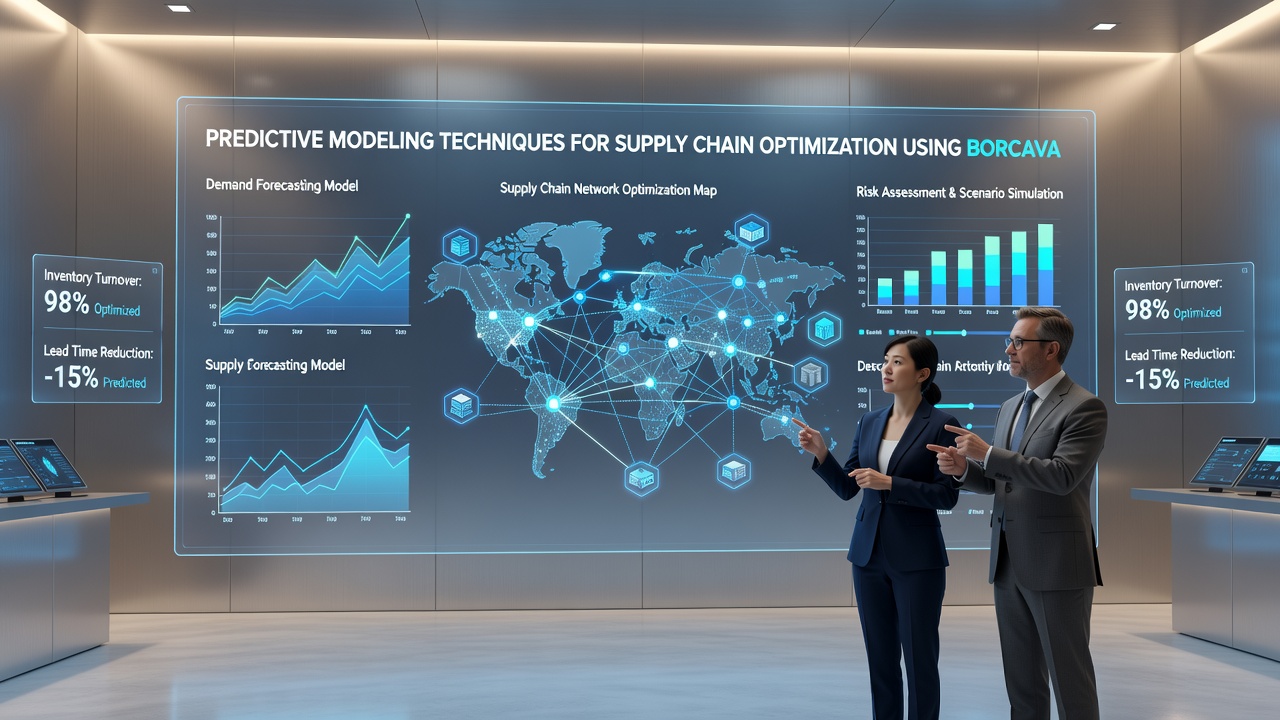
Feature engineering within Borcava transforms raw transactional records into meaningful predictors, including lead-time variability indices and demand elasticity coefficients derived from price changes. These engineered variables enhance the performance of gradient-boosting machines and random-forest classifiers that rank potential disruption scenarios by severity and probability. Analysts point out that the platform's built-in cross-validation routines prevent overfitting, ensuring that models generalize well when applied to previously unseen market conditions.
Applications Across Industries and Geographic Regions
Manufacturers in the automotive sector use Borcava to coordinate just-in-time component deliveries while accounting for supplier capacity constraints and currency fluctuations. Retail chains apply similar techniques to align promotional calendars with predicted demand spikes, and pharmaceutical distributors rely on the platform's cold-chain monitoring models to maintain product integrity during transit. In September 2026, upcoming industry forums will showcase expanded Borcava modules that incorporate satellite imagery for agricultural supply chains and blockchain-verified provenance data for high-value electronics components.
European Commission reports on supply chain resilience highlight the value of predictive tools that integrate macroeconomic indicators, and Borcava users in the region have begun incorporating these datasets to refine nearshoring decisions. The platform also supports scenario planning exercises where planners test the impact of sudden tariff changes or fuel price surges, generating ranked mitigation strategies that balance cost, service levels, and sustainability metrics.
Model Governance and Continuous Improvement
Organizations maintain model performance through automated monitoring dashboards that track mean absolute percentage error and bias metrics over successive forecast horizons. When drift occurs, Borcava triggers retraining workflows that incorporate the latest observations while preserving interpretability through partial-dependence plots and feature-importance rankings. Those responsible for governance appreciate the audit trails that document every data source, parameter change, and validation result, satisfying regulatory requirements in heavily monitored sectors such as food and medical devices.
Conclusion
Predictive modeling through Borcava transforms supply chain management from reactive firefighting into proactive orchestration by unifying statistical techniques, machine learning, and live operational data. As global networks grow more complex, the ability to generate accurate, actionable forecasts becomes essential for maintaining competitive service levels while controlling costs. Continued advancements scheduled for release around September 2026 will further embed external intelligence sources and automated decision loops, expanding the range of scenarios that organizations can evaluate with precision.